
For London-based financial services firms with 25–50 employees
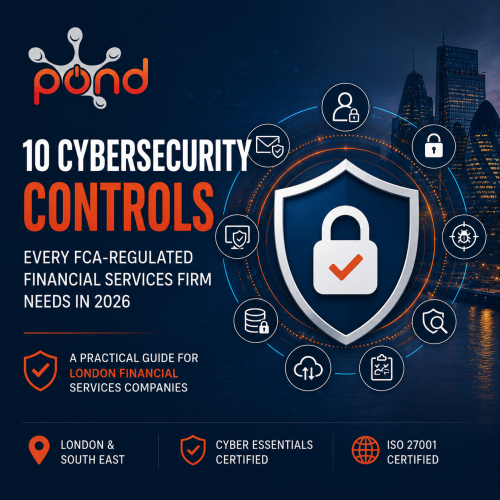
Financial services firms face some of the highest cybersecurity expectations of any industry. In 2026, a typical FCA-regulated business should have at least 10 core cybersecurity controls in place to protect client data, maintain operational resilience, satisfy cyber insurance requirements, and demonstrate compliance with regulatory expectations.
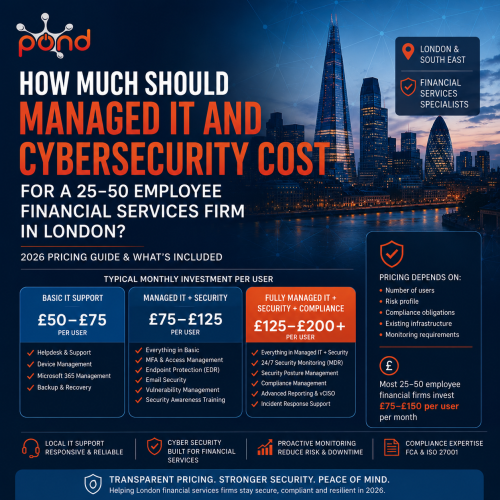
For firms with 25–50 employees, cybersecurity and managed IT costs typically range from £75–£150 per user per month, depending on the maturity of controls, compliance obligations, and monitoring requirements. However, simply spending money on security tools is not enough. The firms that successfully reduce risk focus on implementing the right controls in the right order.
This guide outlines the essential cybersecurity controls every FCA-regulated financial services company should have in place and how to prioritise them effectively.
Why FCA-Regulated Firms Need a Different Security Approach
Financial services firms operate in a highly regulated environment where cybersecurity failures can have significant operational, financial, and reputational consequences.
Threat actors increasingly target:
- Wealth management firms
- Financial advisers
- Asset managers
- Investment firms
- Insurance brokers
- FinTech organisations
At the same time, regulators expect firms to demonstrate:
- Effective risk management
- Operational resilience
- Third-party risk oversight
- Protection of client data
- Incident response capabilities
The result is that cybersecurity can no longer be treated as an IT issue. It has become a board-level business risk.
The 10 Essential Cybersecurity Controls Every Financial Services Firm Needs
The following controls form the foundation of a modern cybersecurity programme.
1. Multi-Factor Authentication (MFA)
MFA should be enforced across:
- Microsoft 365
- VPN access
- Remote desktop services
- Business-critical applications
- Privileged administrator accounts
Compromised credentials remain one of the most common causes of security incidents. MFA significantly reduces this risk.
2. Endpoint Detection and Response (EDR)
Traditional antivirus is no longer sufficient.
Modern EDR solutions provide:
- Behavioural threat detection
- Automated response actions
- Ransomware protection
- Threat hunting capabilities
Every workstation and server should be protected.
3. Advanced Email Security
Email remains the primary attack vector for financial services firms.
Key protections include:
- Anti-phishing controls
- Anti-spoofing protection
- Attachment sandboxing
- URL rewriting
- Executive impersonation detection
4. Vulnerability Management
Many breaches exploit vulnerabilities that have remained unpatched for months.
A formal vulnerability management programme should include:
- Continuous scanning
- Risk-based prioritisation
- Patch management
- Monthly reporting
5. Security Monitoring and Incident Detection
Most organisations are unaware of attacks until days or weeks after compromise.
Effective monitoring includes:
- 24/7 alerting
- Log collection
- Threat detection
- Incident investigation
This is often delivered through a Managed Detection and Response (MDR) service.
6. Backup and Recovery
Backups are critical for operational resilience.
Best practice includes:
- Immutable backups
- Offsite storage
- Regular recovery testing
- Defined recovery objectives
A backup that has never been tested should not be considered a recovery strategy.
7. Access Control and Least Privilege
Users should only have access to systems and data required for their role.
This includes:
- Privileged Access Management
- Joiner-Mover-Leaver processes
- Role-based access controls
- Regular access reviews
8. Security Awareness Training
Employees remain one of the largest security risks.
A structured programme should include:
- Monthly awareness training
- Simulated phishing campaigns
- Executive-specific training
- New starter onboarding
9. Incident Response Planning
Many firms have never tested their response to a cyber incident.
An effective plan should define:
- Roles and responsibilities
- Escalation procedures
- Regulatory notification processes
- Communication plans
- Recovery actions
10. Security Posture Management
Security Posture Management provides continuous visibility of cybersecurity risk across the organisation.
This includes:
- Security configuration monitoring
- Compliance tracking
- Risk scoring
- Continuous improvement planning
For many financial services firms, this becomes the central framework that ties all other security controls together.
A Practical Framework for Prioritising Security Investments
Not every organisation can implement everything at once.
We recommend a three-stage approach.
Stage 1: Establish Security Foundations
Implement:
- MFA
- EDR
- Backup and Recovery
- Email Security
These controls address the most common attack methods.
Stage 2: Improve Compliance Readiness
Add:
- Vulnerability Management
- Security Awareness Training
- Access Controls
- Incident Response Planning
This stage strengthens governance and reduces regulatory risk.
Stage 3: Achieve Continuous Security Improvement
Implement:
- Security Monitoring
- Security Posture Management
- Regular security assessments
- Executive reporting
This provides ongoing visibility and demonstrates security maturity.
The Most Common Security Gaps We See in Financial Services Firms
During assessments, we regularly encounter several recurring issues.
Inconsistent MFA Deployment
Many firms enable MFA for some systems but not all.
Excessive User Privileges
Administrative rights are often granted without adequate justification.
Microsoft 365 Misconfigurations
Common issues include:
- Legacy authentication enabled
- Weak conditional access policies
- Excessive sharing permissions
Lack of Visibility
Many organisations have security tools but no central monitoring capability.
Untested Recovery Processes
Backups exist, but recovery procedures have never been validated.
Each of these gaps can significantly increase cyber risk and may impact regulatory compliance.
Real Client Example
London-Based Fund Management Firm (35 Employees)
Challenge
The firm had grown rapidly and accumulated multiple security solutions over time. Despite significant investment, management lacked visibility into overall security risk.
Key issues included:
- Inconsistent MFA adoption
- No central security monitoring
- Unpatched vulnerabilities
- Limited incident response planning
Approach
A structured security improvement programme was implemented, including:
- Full (enforced) MFA rollout
- Endpoint Detection and Response deployment
- Security monitoring implementation
- Security Posture Management framework
- Staff awareness training
Results
Within six months:
- Critical vulnerabilities reduced by over 80%
- Security monitoring coverage increased to 100% of endpoints
- Improved cyber insurance readiness
- Enhanced management reporting and risk visibility
*Results may vary based on organisational maturity and risk profile.
How Security Posture Management Changes the Conversation
Many firms invest in cybersecurity tools without understanding whether those tools are reducing risk.
Security Posture Management changes this by providing:
- A measurable security baseline
- Continuous risk visibility
- Prioritised remediation actions
- Executive-level reporting
- Compliance alignment
Rather than asking, “Do we have security tools?” organisations can ask:
“How secure are we today compared to last month?”
That shift is critical for modern cyber risk management.
Frequently Asked Questions
Is Cyber Essentials enough for an FCA-regulated firm?
Cyber Essentials is an excellent foundation but should not be considered sufficient on its own. Most firms require additional controls covering monitoring, incident response, vulnerability management, and governance.
Is ISO 27001 mandatory?
No. However, ISO 27001 provides a recognised framework for managing information security and is increasingly viewed as a competitive advantage during client due diligence processes.
How often should cybersecurity controls be reviewed?
At minimum:
- Monthly vulnerability reviews
- Quarterly security assessments
- Annual penetration testing
- Annual incident response testing
Higher-risk firms may require more frequent reviews.
How Pond Group Helps Financial Services Firms Reduce Cyber Risk
Pond Group helps London and South East financial services organisations strengthen cybersecurity through:
- Managed IT Services
- Cybersecurity Services
- Security Posture Management
- Cyber Essentials Support
- ISO 27001 Consultancy
- Risk and Compliance Advisory
Our approach combines operational IT expertise with deep financial services compliance knowledge, helping organisations build resilient, measurable, and continuously improving security programmes.
Next Steps
If you’re unsure whether your current cybersecurity controls meet modern regulatory and business expectations, the best place to start is with an independent security posture assessment.
Understanding your current risks, gaps, and priorities provides the foundation for a more secure and compliant organisation.